
7 Chimney Leak Warning Signs to Look for Before Winter Arrives
A chimney leak might be silently causing damage in your Minneapolis or Bloomington home right now. Unlike roof leaks or plumbing leaks that announce themselves dramatically, chimney leaks develop quietly, infiltrating hidden spaces within your walls and attic.
By the time you notice visible water damage, the leak has often been worsening for weeks or months. Minnesota’s freeze-thaw cycles accelerate damage exponentially—water that entered in October becomes a structural emergency by February.
Recognizing chimney leak warning signs early is your best defense against catastrophic water damage and expensive remediation. Here are the seven critical signs that indicate your chimney is leaking and requires immediate professional attention.
Warning Sign #1: Water Stains on Interior Walls or Ceilings Near the Chimney
The most obvious warning sign is also the most urgent. Water stains on interior drywall, plaster, or painted surfaces indicate water has already penetrated your home’s structure.
What to Look For
Interior staining near the fireplace: Brown, tan, or grayish discoloration on walls or ceiling surfaces adjacent to the chimney indicates water has traveled from the chimney structure into your home. The stain is visible because water has been present long enough for mineral deposits to accumulate.
Stains in unexpected locations: Water doesn’t stay contained to one spot. Check ceilings and walls on multiple floors if your chimney extends through several levels. Water often appears in locations away from the obvious chimney area as it travels through wall cavities.
Fresh vs. old stains: Fresh stains indicate active leaks requiring urgent attention. Old, dried stains suggest water intrusion has been ongoing for extended periods. Either way, professional evaluation is critical.
Why This Sign Matters
If water is visible inside your home, it has already penetrated deep into your walls. Hidden water damage is developing in insulation and wood framing. Mold may already be growing. The faster you act, the less extensive the remediation will be.
Warning Sign #2: Musty or Moldy Odors Around the Fireplace
A distinctive musty smell around the fireplace indicates moisture accumulation inside walls or chimney structures. This odor develops when water-saturated materials begin decomposing.
What to Look For
Persistent musty smells: These don’t come and go—they’re constant indicators of ongoing moisture problems. The smell intensifies after rain or humid weather.
Moldy odors specifically: A stronger, distinctly moldy smell indicates mold colonies are already developing in hidden spaces. Mold requires moisture plus time. Its presence means water has been intrude for weeks or longer.
Smell concentration near the chimney: Notice whether the odor is strongest immediately near the fireplace or if it spreads throughout the room. Localized strong odors indicate the problem is specifically chimney-related.
Why This Sign Matters
Mold growth represents a health hazard and an indicator that extensive moisture has accumulated. Remediation becomes more complex and expensive when mold is involved. Early detection before mold becomes established is critical.
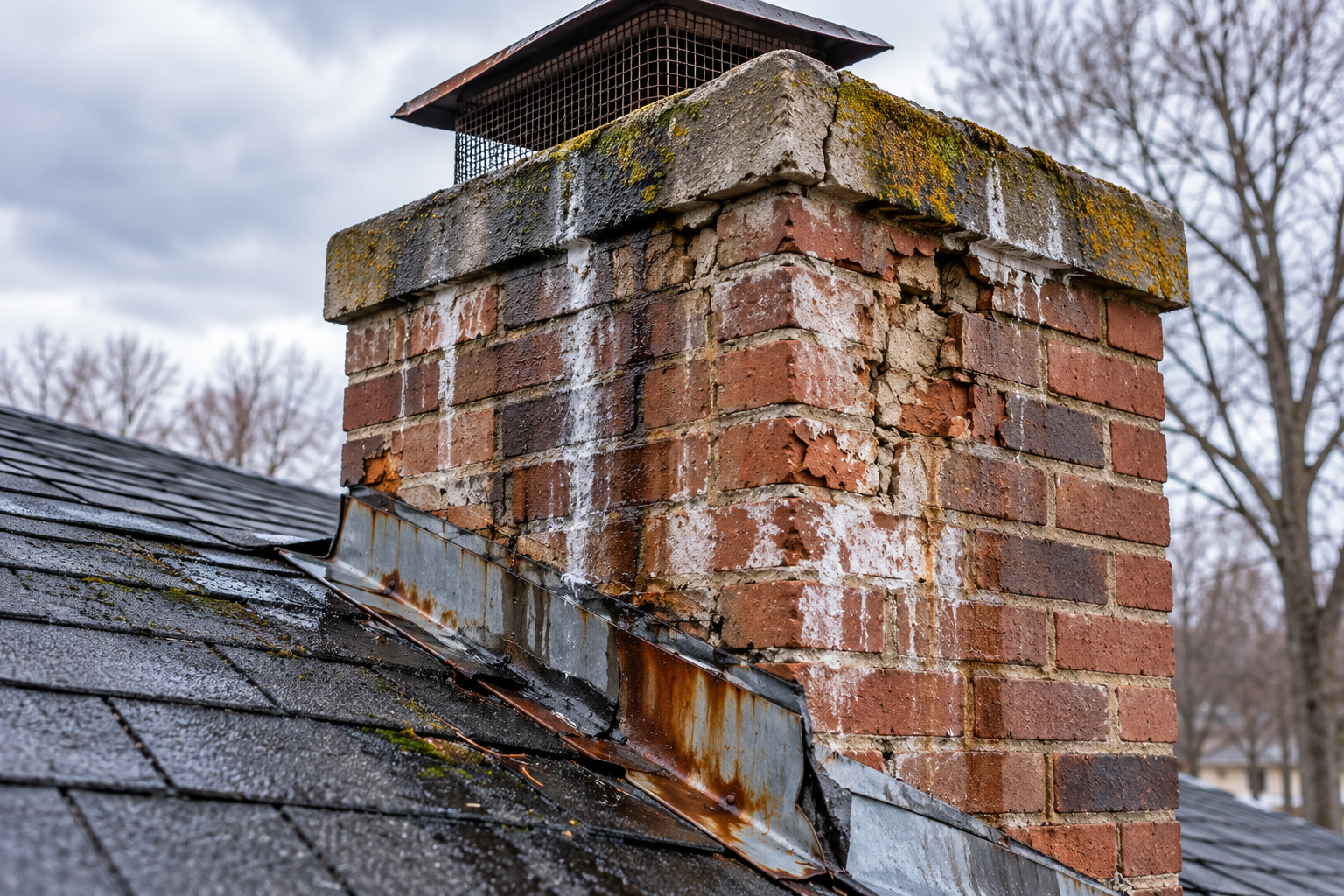
Warning Sign #3: Visible Cracks or Gaps in Exterior Chimney Mortar
Examining your chimney’s exterior (from ground level) can reveal the water entry source. Deteriorated mortar is a common culprit.
What to Look For
Missing or crumbly mortar between bricks: Mortar should look solid and uniform. If you can see gaps, if mortar looks soft or powdery, or if chunks are missing, water can enter through those gaps.
Hairline cracks in mortar: Even tiny cracks allow water to infiltrate the chimney structure. Once water enters, freeze-thaw cycles widen the cracks progressively.
Uneven mortar appearance: If some areas look different from others—some darker, some lighter, some recessed—this indicates varying stages of deterioration.
Why This Sign Matters
Deteriorated mortar is one of the most common sources of chimney leaks. The good news is that professional repointing can address it before extensive water damage develops. Early detection makes repairs simpler and less expensive.
Warning Sign #4: Efflorescence (White Powder on Exterior Masonry)
White powder or mineral deposits on your chimney’s exterior indicate water is traveling through the masonry and leaving mineral deposits as it evaporates.
What to Look For
White, chalky substance on brick or mortar: This is efflorescence—mineral salts from water traveling through masonry. Heavy efflorescence indicates significant water movement through the structure.
Concentrated deposits in specific areas: If efflorescence is heavy on one side of the chimney or concentrated in certain locations, this indicates where water is most actively entering and exiting.
New deposits appearing after rain: If efflorescence appears or intensifies after rainy periods, this confirms active water movement through the masonry.
Why This Sign Matters
Efflorescence is evidence that water is penetrating your chimney. While the powder itself isn’t dangerous, it’s a clear indicator that water intrusion is occurring and will eventually cause interior damage if not addressed.
Warning Sign #5: Damaged, Missing, or Separated Flashing Where Chimney Meets Roof
Flashing is metal material that seals the gap where your chimney penetrates the roof. Damaged flashing is a major source of chimney leaks.
What to Look For
Visible rust on flashing: Orange or brown staining indicates corrosion. Corroded flashing develops holes and separates, allowing water entry.
Gaps between flashing and chimney: There should be no visible daylight between metal flashing and the chimney. Gaps allow water to run between the chimney and roof.
Bent or tilted flashing: Flashing should lie flat against the roof and chimney. Bent or misaligned flashing doesn’t shed water properly.
Missing sections of flashing: Large gaps in flashing are obvious water entry points.
Why This Sign Matters
Flashing failure is one of the most common leak sources. The critical point is that flashing is located at the roof line—water from flashing leaks can travel into walls, attic spaces, and throughout your home’s structure. Professional flashing repair stops water entry at the source.
Warning Sign #6: Damaged, Cracked, or Missing Chimney Crown
The chimney crown is the concrete seal at the very top of the chimney. A cracked or missing crown allows water to enter directly from above.
What to Look For
Visible cracks in the concrete crown: Even hairline cracks allow water entry. Look at the crown from ground level with binoculars if needed.
Chunks or pieces missing from the crown: Significant deterioration indicates the crown is failing and requires immediate replacement.
Crown separating from the chimney: The crown should be flush with the chimney top. Separation creates gaps where water enters.
Uneven or low spots in the crown slope: The crown should slope outward to shed water. Flat spots or low areas cause water pooling and entry.
Why This Sign Matters
Crown damage allows water to enter at the highest point of the chimney system. Water then travels down through the entire flue and chimney structure. Crown repair is often a priority because it stops the most direct water entry path.
Warning Sign #7: Animal Sounds, Droppings, or Debris in the Chimney
While not strictly a water sign, animal entry indicates your chimney protection is compromised—and the gap animals entered through also admits water.
What to Look For
Scratching or scurrying sounds: Especially in early morning or evening when animals are active. Sounds from inside the chimney indicate entry points.
Animal droppings in the firebox or hearth: Visible feces indicate animals have accessed the interior.
Debris accumulation: Leaves, twigs, or nesting material in the fireplace indicates animals are accessing the chimney and/or the cap is failing.
Visible entry holes or gaps: Look for openings around the chimney where animals could enter.
Why This Sign Matters
The entry points animals use are the same entry points water uses. Animals signal that your chimney’s protective barriers—the cap, flashing, and crown—are compromised. Professional evaluation should address both animal access and water intrusion.
Why Timing Is Critical in Minnesota’s Climate
Minnesota homeowners face unique urgency around chimney leak detection and repair.
Freeze-Thaw Cycles Accelerate Damage
Once water enters your chimney structure, Minnesota’s temperature swings cause catastrophic damage:
- Water freezes inside masonry and brick
- Ice expands approximately 9% in volume
- Expansion creates pressure that fractures structures
- Freeze-thaw cycles repeat 50+ times each winter
- Each cycle worsens damage exponentially
A leak detected in October might allow several inches of water damage by February. By spring, structural damage can be extensive.
Hidden Damage Compounds Rapidly
Water inside walls doesn’t just damage the chimney—it travels into insulation, wood framing, and wall cavities. Damage spreads and multiplies:
- Insulation loses effectiveness as it absorbs moisture
- Wood framing absorbs water and becomes vulnerable to rot
- Mold develops in hidden spaces where moisture is trapped
- By the time interior water stains become visible, extensive hidden damage has occurred
Acting immediately upon detecting warning signs prevents the cascade of damage that accelerates through winter.
What You Can Safely Observe vs. Professional-Only Assessment
You can identify warning signs safely without putting yourself at risk. Know the boundaries of safe observation.
Safe Observations You Can Make
- Looking at water stains on interior surfaces
- Smelling for musty odors
- Looking at exterior mortar from ground level
- Observing efflorescence on exterior masonry
- Watching for exterior flashing separation
- Looking at crown condition from ground level
- Listening for animal sounds
Professional-Only Assessments
- Climbing roofs to inspect closely
- Entering attic spaces near the chimney
- Accessing the chimney crown or cap
- Inspecting the chimney interior (flue)
- Determining precise leak sources
- Assessing hidden water damage behind walls
- Recommending and performing repairs
Professional chimney inspectors have specialized equipment, safety training, and expertise to accurately assess conditions and recommend appropriate repairs.
When to Schedule Professional Evaluation
The answer is straightforward: immediately upon noticing any warning signs.
Urgent Professional Evaluation Needed If
- You see water stains on interior surfaces
- You detect musty or moldy odors
- You see significant exterior damage (cracked crown, damaged flashing)
- You hear animal sounds in the chimney
- You notice debris or animal droppings in the fireplace
Recommended Professional Evaluation Schedule
Even without obvious warning signs, professional inspection before fireplace season (typically September-October) is standard practice. Annual inspection allows early detection of developing problems.
Cost of Early Detection vs. Delayed Intervention
The financial logic for prompt professional attention is compelling.
Early Detection Costs (When Signs First Appear)
- Professional inspection and assessment: $200-$500
- Chimney repair (typical): $500-$2,000
- Restoration of minor water damage: $200-$500
Total early intervention: $900-$3,000
Delayed Intervention Costs (After Months of Worsening)
- Professional assessment: $200-$500
- Extensive chimney repairs: $1,500-$5,000
- Water damage remediation: $1,000-$5,000
- Insulation replacement: $500-$2,000
- Structural wood repair: $2,000-$10,000
- Mold remediation: $1,000-$5,000+
Total delayed intervention: $6,200-$27,500+
The difference between prompt action and delay is often $15,000-$20,000 in additional costs.
Services and Service Areas in Minnesota
We proudly provide chimney repair MN, including:
Buffalo, MNAnnandale, MNMonticello, MNWaverly, MNClearwater, MN
Our chimney and fireplace repair services include:
Frequently Asked Questions
What causes water stains around fireplaces in Minnesota specifically?
Contact a professional chimney inspector immediately. Water stains indicate water has already penetrated your home. Professional evaluation determines the leak source and extent of damage. Don’t wait—water damage accelerates rapidly, especially in Minnesota’s climate.
Can chimney leaks develop without visible signs?
Yes. Water damage often develops silently inside walls and attic spaces before becoming visible. This is why annual professional inspection is recommended—early detection catches problems before extensive damage occurs.
How quickly do Minnesota freeze-thaw cycles worsen chimney leaks?
Very quickly. Water that enters an unrepaired leak in October can cause significant damage by mid-winter. Each freeze-thaw cycle (which occurs repeatedly through Minnesota winters) worsens damage exponentially.
Should I wait until spring to repair a chimney leak I notice in fall?
Absolutely not. Every month you delay through winter allows freeze-thaw cycles to worsen damage. A repair costing $1,500 in October can require $10,000+ in remediation by spring.
Can I apply sealant or caulk to stop a chimney leak temporarily?
Temporary fixes rarely work. Caulk may slow water entry briefly but doesn’t address the underlying problem. Water continues entering through cracks, gaps, or deteriorated components. Professional repair addressing the source is the only lasting solution.
What if I see efflorescence but no water stains inside?
Efflorescence indicates water is traveling through your masonry. While you may not see interior damage yet, professional evaluation should determine whether water is accumulating inside walls. Early detection prevents extensive hidden damage.
How can I tell if my chimney crown is cracked?
Look at your chimney top from ground level using binoculars if needed. Any visible cracks, especially large cracks, indicate crown failure. Even hairline cracks allow water entry. Professional evaluation can determine whether repair or replacement is needed.
Is a damaged chimney cap an emergency?
Yes. A missing or severely damaged cap allows water to enter directly into the flue. Professional cap replacement should be scheduled immediately—certainly before freeze-thaw season begins.
Can animals entering my chimney cause water damage?
Indirectly. Animal entry through gaps in the chimney cap, crown, or flashing indicates the same gaps admit water. Additionally, animal nests can block the flue and trap moisture. The gaps allowing animals also allow water.
Should I have my chimney inspected even if I don't see obvious warning signs?
Yes. Professional inspection before fireplace season is recommended annually. Early detection of developing problems prevents extensive damage. Many problems develop silently before becoming visible.
What's the best time of year to schedule chimney leak repair in Minnesota?
September through October, before fireplace season and before freeze-thaw cycles intensify. Repairs completed in autumn are protected through the entire winter. Delaying until winter or spring means freeze-thaw damage is already accelerating.
Will homeowner's insurance cover chimney leak damage?
Coverage depends on your specific policy and whether damage is considered sudden or maintenance-related. Many policies don’t cover water damage from neglected maintenance. Contact your agent immediately if you suspect a leak, but don’t rely on insurance to determine action.
How long does professional chimney leak repair typically take?
Timeline depends on the repair scope. Simple crown or flashing repair might take 1-2 days. Extensive water damage remediation can take weeks. A professional can estimate after assessment.
Can chimney leaks cause mold to grow?
Yes. Water intrusion creates humid conditions perfect for mold development. Mold thrives in hidden spaces behind walls where moisture is trapped. By the time you smell mold, colonies may already be well-established.
What should I tell a professional inspector about warning signs I've noticed?
Provide specific information: when you first noticed signs, whether they’re worsening, what weather conditions trigger them (after rain, during freeze-thaw), and their locations. This helps the inspector prioritize inspection areas and identify the problem source.
If I see only one warning sign, is professional evaluation still necessary?
Yes. One warning sign indicates water intrusion is occurring. Professional evaluation determines how extensive the problem is—whether it’s minor and easily repaired or if hidden damage has already developed.