Chimney Roofline Problems Minnesota: What Your Roofline Is Trying to Tell You
Where the chimney meets the roof is the hardest-working joint on your house. Chimney roofline problems Minnesota homeowners notice in November usually started months earlier, during a summer thunderstorm or the first freeze-thaw cycle of the year.
This guide explains the seven roofline symptoms that matter, what each one points to, which checks are safe from the ground, and when a professional needs to look. Whether you live in Minneapolis or near Maple Lake, the same warning signs apply.
What Are Chimney Roofline Problems?
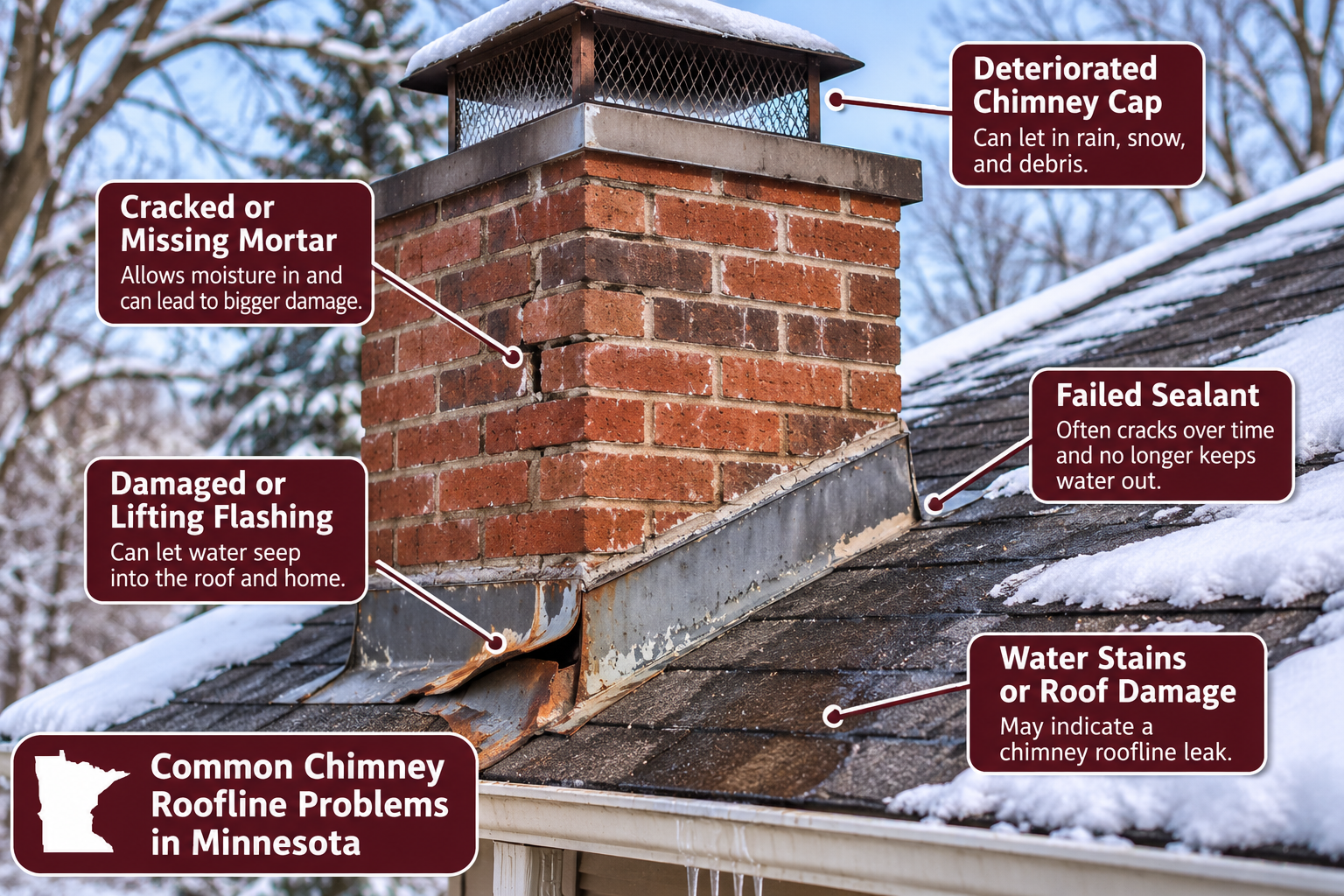
Chimney roofline problems Minnesota homes develop are failures at the junction where the chimney passes through the roof: cracked or separated flashing, a damaged crown, loose or spalling masonry, and water stains or leaks appearing on ceilings near the chimney.
Each part has a job. Flashing seals the joint, the crown sheds water off the top, and the masonry carries the load. When any one of them fails, water enters, freeze-thaw widens the damage, and the problem travels down the flue into the firebox.
Why the Roofline Is Minnesota’s Weak Point
Three local conditions attack this junction more aggressively here than in milder states.
Freeze-thaw cycles. Water that slips past a cracked crown or failing flashing freezes, expands and pries the joint open wider every winter. Our guide to winter chimney masonry Minnesota explains the cycle in detail.
Snow load and ice dams. Snow sitting against the uphill side of a chimney melts, refreezes at the eaves and pushes water sideways under flashing that looked fine in July.
Long wet seasons. Summer thunderstorms and spring thaw dump water on a roofline that then sits through months of freezing temperatures. Our guide to chimney water intrusion Minnesota covers the common leak paths.
That combination is why chimney roofline problems Minnesota winters expose almost always trace back to the roofline first, not the fireplace.
7 Urgent Chimney Roofline Problems Minnesota Homeowners Should Recognize
Each symptom points to a different component. Read them as clues, not a diagnosis.
1. Rust Streaks or Separation at the Flashing
Flashing is the metal that seals the chimney-to-roof joint. Rust streaks running down the shingles, or metal that has pulled away from the brick, means the seal has failed.
Chimney roofline problems Minnesota storms cause most often begin exactly here. Our chimney flashing repair page covers what a fix involves.
2. Cracked, Chipped or Missing Crown
The crown is the sloped cap on top of the chimney. Hairline cracks are common; wide gaps, missing chunks or pieces sitting at an angle are not.
Chimney roofline problems that start at the crown let water pour straight down the flue. Our chimney crown repair guide explains why this repair should not wait.
3. Loose, Spalling or Missing Bricks
Spalling means the face of a brick flakes or pops off, usually because water froze inside it. Loose bricks and crumbling mortar joints near the roofline signal the same story.
Chimney roofline problems Minnesota freeze-thaw cycles create often appear as a patch of damaged masonry just above the flashing line.
4. Water Stains on the Ceiling Near the Chimney
A yellow or brown ring on the ceiling close to the chimney is the clearest indoor clue. It means water is entering at the roofline and traveling down before it drips.
Chimney roofline problems that show up indoors have usually been running for months. The stain is the end of the path, not the start.
5. White, Chalky Deposits on the Masonry
That powder is efflorescence: mineral salts left behind when water moves through brick and mortar. It tells you water is passing through the chimney, whether or not you see a leak yet.
Chimney roofline problems Minnesota moisture creates often surface as efflorescence first. Clean the surface, and the source still needs fixing.
6. Daylight or Gaps Where the Chimney Meets the Roof
From inside the attic, or from the yard, a visible gap where flashing should sit means the joint is open. From the ground, look for shingles that lift or curl near the chimney.
Chimney roofline problems you can see from a distance deserve an inspection rather than a ladder. Never climb the roof to check.
7. A Cap That Is Missing, Rusted or Out of Place
The cap keeps rain and animals out of the flue. A missing or damaged cap sends water straight down the chimney and invites nests.
Chimney roofline problems at the very top often go unnoticed for years because nobody looks up. Note it from the ground and mention it to your technician.
Safe Checks From the Ground
These checks stay on the floor and in the yard. No ladders, no roof work.
What You Can Safely Observe
- Stand back in the yard and look up at the chimney: note rust, missing crown pieces, loose bricks or a damaged cap.
- After rain or snowmelt, look for water stains on the ceiling nearest the chimney.
- Check the ceiling and walls for efflorescence, peeling paint or musty odors near the chimney.
- Photograph anything new from several angles for your technician.
- Note whether the fireplace smells damp or musty when it rains.
What Belongs to a Professional
Never climb the roof, remove shingles, lift flashing or patch masonry yourself. Chimney roofline problems live above your reach for good reason: the work involves height, steep surfaces and materials that need to fit exactly. Any roofline work is professional-only.
Red Flags: Do Not Climb, Call Instead
Stop and schedule an inspection if you notice:
- Active water dripping from the chimney into the firebox or onto the hearth
- Loose or shifted bricks near the roofline
- A visibly missing or displaced crown piece or cap
- Ceiling stains that grow after every rain
- Ice forming on or inside the chimney during cold snaps
- A chimney fire history, an appliance change or a recent home purchase
If a carbon monoxide alarm sounds, leave the house immediately and call 911. Keep working smoke and carbon monoxide alarms on every level.
How Professionals Evaluate Chimney Roofline Problems
What an Inspection Covers
A technician inspects the crown, cap, flashing, masonry and accessible flue, often with a camera from inside, and checks for moisture paths. The NFPA 211 standard defines three inspection levels. Level 1 covers readily accessible parts, and Level 2 adds a camera scan of the flue.
The Chimney Safety Institute of America (CSIA) recommends an annual inspection, which is when roofline damage gets caught before it reaches the ceiling.
Repairs That Follow the Diagnosis
- Flashing repair or replacement at the chimney-to-roof joint
- Crown rebuild or sealing
- Repointing or replacing damaged masonry
- Cap installation or replacement
- Interior work when moisture has reached the firebox or liner
The right fix follows the source. Sealing a stain inside while the roofline stays open invites the problem to return. Our chimney repair page covers the full scope, and if moisture has reached the flue, our chimney liner inspection Minnesota guide explains what comes next.
Choosing a Qualified Professional
Look for CSIA certification and a Minnesota contractor license, and ask for both numbers. Free homeowner guidance at Verified Chimney Pros helps you ask better questions before you hire.
Chimney Roofline Problems Minnesota Prevention Checklist
- Every autumn: look up from the yard after a rain and note anything new.
- After storms: check the ceiling nearest the chimney for fresh stains.
- After thaws: look for efflorescence, damp brick and ice on the chimney.
- Never wait: roofline damage grows through winter, so book repairs in fall when the weather allows.
- Every year: schedule a professional inspection before the heating season, as CSIA recommends.
Chimney roofline problems Minnesota winters make worse are far cheaper to fix in November than in March.
Chimney Roofline Help in Maple Lake, Minneapolis and the Twin Cities
Midwest Chimney Repair works from Maple Lake and serves homeowners within an approximately 25-mile radius. If you live in Minneapolis or elsewhere in the Twin Cities, call to confirm whether your address is covered. Our team can walk you through any chimney roofline problems Minnesota weather has exposed.
Services and Service Areas in Minnesota
We proudly provide chimney repair MN, including:
Buffalo, MNAnnandale, MNMonticello, MNWaverly, MNClearwater, MN
Our chimney and fireplace repair services include:
Frequently Asked Questions
What causes chimney problems at the roofline?
Chimney roofline problems Minnesota homes develop usually start with failed flashing, a cracked crown or moisture that freezes and pries joints open. Summer storms and winter freeze-thaw cycles attack the same junction from both directions.
How do I know if my chimney flashing is bad?
Rust streaks on the shingles, metal pulling away from the brick, or water stains on the ceiling nearest the chimney are the clearest clues. Photograph them from the ground and schedule an inspection rather than climbing the roof.
Are chimney roofline problems dangerous?
They can be. Water entering at the roofline damages masonry, the liner and the firebox, and structural loosening near the top of the chimney is a safety concern. Any loose brick or growing ceiling stain deserves a professional evaluation.
Why does my ceiling stain only near the chimney?
Water that enters at the roofline travels down the chimney and drips onto the ceiling below, so the stain stays close to it. Chimney roofline problems that show up indoors have usually been running for months.
What is efflorescence on a chimney?
It is a white, chalky powder left behind when water moves through brick and mortar. Efflorescence means moisture is passing through the chimney even if you have not seen a leak yet.
Can I repair chimney flashing myself?
No. Flashing work involves roof height, steep surfaces and seals that must fit exactly. Chimney roofline problems belong to trained professionals with the right access and materials.
How often should a chimney be inspected?
CSIA recommends an annual chimney and fireplace inspection, and the roofline is a core part of it. Schedule before the heating season so roofline repairs happen in workable weather.
Does freeze-thaw weather damage the roofline?
Yes, indirectly. Water that enters through a cracked crown or failing flashing freezes, expands and widens the joint every winter. That is why chimney roofline problems Minnesota winters expose keep growing.
What does a Level 2 inspection include?
Under NFPA 211, Level 1 covers readily accessible parts of the chimney and fireplace. Level 2 adds a camera scan of the flue, and is advised after a chimney fire, an appliance change or a home sale.
How much does chimney roofline repair cost?
Cost depends on the component involved, roof access and the extent of water damage. A professional inspection gives you a clear scope and price before any work begins.
Should I worry about a missing chimney cap?
Yes. A missing cap sends rain straight down the flue and invites nests. Note it from the ground and have a professional handle installation: never climb the roof yourself.
When is the best time to schedule roofline repairs?
Fall, before freeze-thaw season, is ideal. Chimney roofline problems Minnesota winters worsen are cheaper and easier to fix in dry, mild weather than after a winter of spreading damage.
Can a roofline leak damage my fireplace?
Yes. Water that enters at the roofline runs down the flue and into the firebox, where it chills draft and cracks masonry through freeze-thaw cycles. Our guide to chimney water intrusion Minnesota covers the path.
Does Midwest Chimney Repair serve Minneapolis?
We are based in Maple Lake with an approximately 25-mile service radius. Twin Cities homeowners should call (612) 655-8181 to confirm whether their address is covered.
How do I schedule a chimney and roofline inspection?
Call (612) 655-8181 or email mnchimneyrepair@gmail.com. Our hours are Monday–Friday, 9:00 AM–4:00 PM. Photos of the roofline and any ceiling stains help us prepare.